

A clothing size chart can help you choose a better fit, but only when you know what the numbers mean. Some charts describe your body measurements, while others show the dimensions of the finished garment. Confusing the two can leave you with a dress that pulls or pants that feel much looser than expected.
Learning how to read a women’s clothing size chart starts with three things: your current measurements, the chart for the exact item and a clear idea of how you want it to fit. Your usual size is a starting point, not a promise that every brand will fit the same way.
I’ll walk you through the details worth checking before you order, especially when your bust, waist and hips fall into different size ranges.
1. Open the Chart for the Exact Product
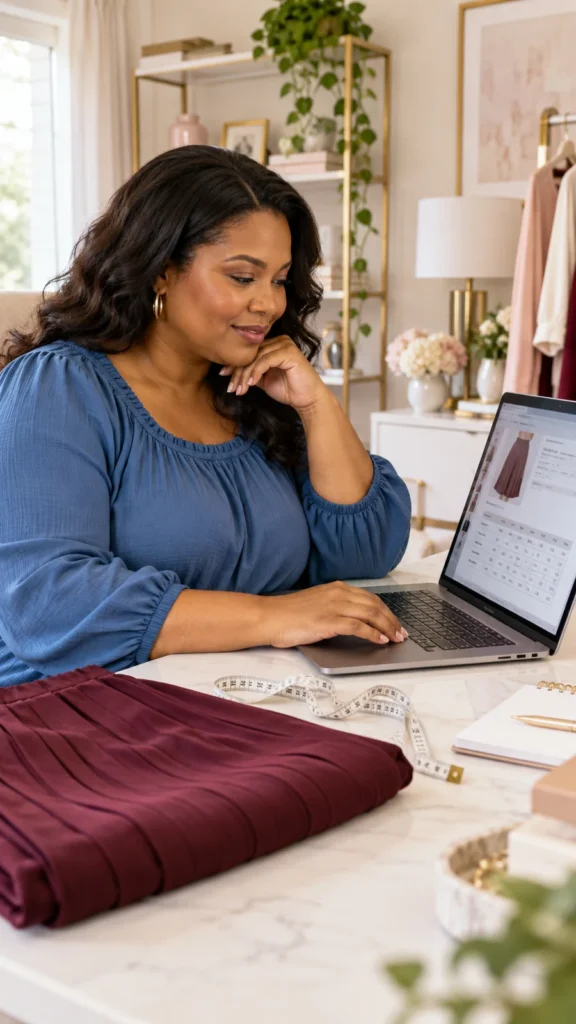
Start with the size chart attached to the item you want to buy. A retailer may sell several brands, each with its own measurements. Marketplace listings can also include seller-specific charts that differ from the platform’s general sizing guide.
Look near the size selector, in the product images or in the description. Check whether the chart applies to that particular style, rather than another garment shown in the listing.
- Confirm the brand and product name.
- Check whether you are viewing US or another country’s sizing.
- Look for petite, tall, regular or plus-size options.
- Read any instructions explaining how the measurements were taken.
Style Tip: Save the product’s size chart with your order details so you can compare it with the garment when it arrives.
2. Keep Your Current Body Measurements Nearby
Your bust, natural waist and fullest hip measurements provide a useful starting point. Depending on the garment, you may also need your inseam, upper-arm circumference or preferred skirt length.
Use measurements taken with a flexible, non-stretch tape. Keep it comfortably against your body, stand naturally and avoid measuring over bulky clothes.
If you have not measured recently, check again before ordering a fitted garment. A familiar size label can feel reassuring, but current measurements give you more useful information.
3. Check Whether the Chart Uses Inches or Centimeters

Find the unit label before comparing any numbers. A waist measurement of 36 inches is very different from 36 centimeters.
Some charts let you switch between units. Others show both, or include the unit in a small heading. If you need to convert a measurement, one inch equals 2.54 centimeters.
For example, a 40-inch hip measurement is 101.6 centimeters. Keep the decimal while comparing the chart rather than rounding down to make a smaller size appear suitable.
Style Tip: Record your measurements in both units to make shopping across different brands easier.
4. Understand Body Measurements Versus Garment Measurements
Body Measurement Charts
These describe the body measurements a size is intended to fit. Compare your measurements directly with the chart and follow the brand’s measuring instructions.
A chart may show a range, such as a waist of 34–36 inches, or a single reference measurement. Do not assume a single number represents the largest comfortable fit unless the seller explains that.
Garment Measurement Charts
These describe the clothing itself. A relaxed shirt may measure larger than your bust because it includes room for movement. A stretchy garment designed for a close fit may measure smaller than your body before the fabric stretches.
The difference between body and garment measurements is often called ease. The amount needed depends on the fabric, construction and intended fit.
For garment measurements, compare the item with a similar piece you already own that fits comfortably. Make sure both were measured using the same method.
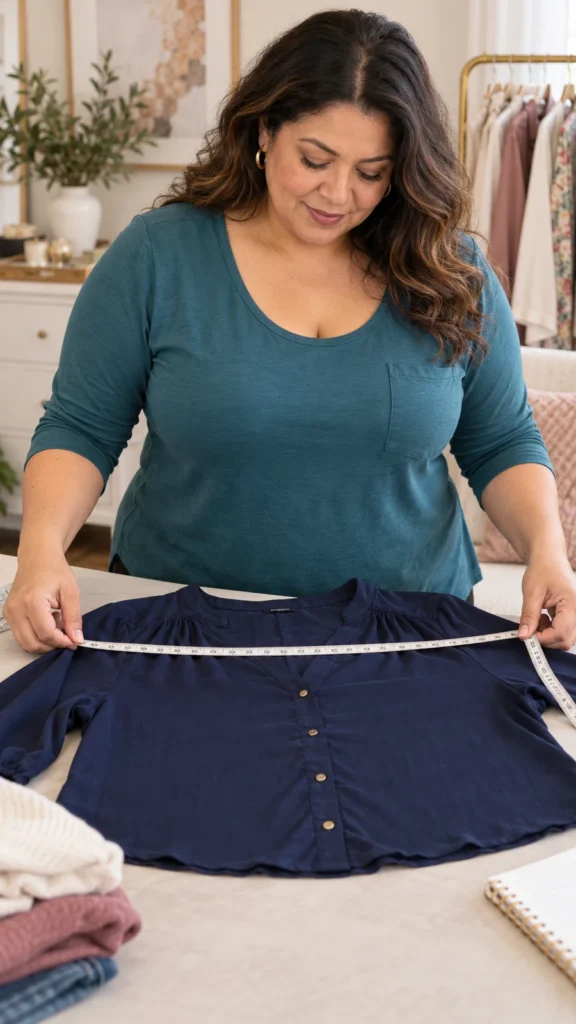
5. Recognize Measurements Taken with Clothing Laid Flat
Some sellers measure garments on a flat surface. A measurement labeled “waist width” or “across chest” may describe one side rather than the full circumference.
For example, a waistband measuring 18 inches across may have an approximate circumference of 36 inches. However, do not double every number automatically: a chart labeled “waist circumference” may already show the full measurement.
- Look for terms such as flat width, half chest or circumference.
- Check whether an elastic waistband was measured relaxed or stretched.
- Follow any measurement diagram supplied by the seller.
- Ask for clarification if the chart does not explain its method.
Style Tip: An elastic waistband’s maximum stretch does not necessarily describe its most comfortable everyday fit.
6. Compare Every Measurement That Matters
Choose a size by considering the garment’s fitted areas rather than one convenient measurement.
- Blouses and fitted tops: Check bust, shoulders and upper-arm room.
- Jeans and pants: Check waist, hips, rise, thigh room and inseam.
- Fitted skirts: Compare both waist and hips, plus the length.
- Fitted dresses: Check bust, waist and hips together.
- Blazers: Consider shoulders, bust, sleeves and room for the layer underneath.
- Jumpsuits: Check torso length as well as bust, waist, hips and inseam when those details are available.
A dress can match your waist measurement and still feel restrictive at the bust. Likewise, jeans that close comfortably may need a different cut if the thighs or rise feel tight.
7. What If You Match Different Sizes?

It is common for your measurements to fall into more than one size. That does not mean you measured incorrectly or that your body needs to change.
Imagine a hypothetical body-size chart where your bust falls into XL, your waist into L and your hips into XXL. For a fitted, non-stretch dress, the hip measurement may make XXL the more practical starting point. For a relaxed A-line dress, bust and waist fit may matter more because the skirt has additional room.
Always check the actual cut and garment measurements before making that choice. A larger size can create unwanted looseness elsewhere, and some garments are easier to alter than others.
Style Tip: If you regularly need more hip room with a smaller waist, look for cuts designed around those proportions instead of relying only on sizing up.
8. Read the Fabric and Fit Description
Words such as fitted, relaxed and oversized describe the intended silhouette. They help explain why two garments with similar labels can fit differently.
Fabric matters too. A rigid woven skirt behaves differently from a stretchy knit skirt, even if both share the same size label.
- Non-stretch fabric: Allow comfortable movement at the fitted areas.
- Stretch fabric: Check the intended fit and any stretch information provided.
- Lined garments: Remember that the lining may stretch less than the outer fabric.
- Elastic or smocked sections: Check both relaxed measurements and the seller’s fit guidance.
An elastane percentage alone does not tell you exactly how much a finished garment will stretch. Avoid automatically ordering a smaller size simply because the fabric contains stretch.
9. Use Reviews as Supporting Information
Reviews can reveal patterns such as restrictive sleeves, a short torso or a waistband that feels firm. They are most useful when reviewers provide measurements, the size ordered and their preferred fit.
One person saying “runs small” is not enough to determine your size. Compare several relevant reviews and use them alongside the product chart.
Customer photos can help you understand length and silhouette, but differences in height, proportions, pose and alterations can change how the same garment looks.
10. Check Length and Return Options Before Ordering

A size chart may help with circumference while telling you little about length. Look separately for inseam, sleeve length, skirt length or dress length.
Compare those measurements with a garment you already like. For pants, consider the shoes you plan to wear. For skirts and dresses, check where the seller begins its length measurement.
Before ordering, read the current return conditions for that exact item. Confirm any return deadline, fees or final-sale restrictions rather than assuming every product follows the same rules.
A Quick Size-Chart Checklist
- I am using the chart for this exact product.
- I know whether the measurements are inches or centimeters.
- I understand whether the chart describes a body or a garment.
- I have checked all the fitted areas.
- I have considered fabric, lining and intended fit.
- I have checked the garment length.
- I understand the item’s return conditions.
Frequently Asked Questions
Are US clothing sizes the same across brands?
No. Measurements and proportions can vary between brands and clothing ranges. Use the specific size chart each time.
Are XL and 1X interchangeable?
Not necessarily. Plus-size and straight-size ranges may use different measurements and garment proportions. Compare the charts directly.
Should I size up if I am between sizes?
It depends on the fitted areas, fabric and silhouette. Check garment measurements and fit guidance before choosing either size.
What should I do if there is no useful size chart?
Ask the seller for the measurements you need. For a fitted garment, it may be more practical to choose a listing with clearer sizing information.
Let the Measurements Guide Your Choice
A useful size chart helps you shop for your body as it is today. Start with accurate measurements, understand what the chart describes and consider how you want the garment to feel. The best size is the one that gives you the fit and movement you enjoy.
Start with current numbers using our guide to measuring yourself for clothes.
YOUR PERSONAL STYLE TOOLS
Want your next look styled together?
Build a personalized outfit or complete your existing look with matching hair, nails, shoes and accessories.